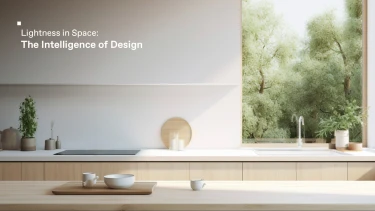
Smart solutions designed for modern lifestyles
There was a moment when the kitchen began to fill up. Hoods dominating the space above the cooking area, standalone appliances occupying every surface, each new need solved by adding yet another appliance. Innovation became visible, but it also began to take up more and more space.
Over time, this accumulation revealed something evident: more technology does not always mean a better spatial experience.
Today, the new generation of kitchens moves in the opposite direction. Instead of adding elements, design seeks to integrate them. Technology becomes part of the cabinetry, surfaces are freed, and the architecture of the space regains clarity.
From this evolution emerges a new way of thinking about the contemporary kitchen: Lightness in Space.
From Visible Excess to the Intelligence of Design
True lightness in the kitchen appears when each function is integrated with precision into the space. When every element finds its place within the design, the space becomes more fluid. Movement becomes simpler, visual perception clears, and the experience of cooking changes completely.
In this context, innovation no longer seeks the spotlight. Its real value lies in improving the dynamics of the space without interrupting them.
At Elica, we incorporate technologies like Panel Ready, which allow you to integrate the appliance directly into the kitchen cabinetry. This way, specialized functions such as beverage storage are integrated into the space without disrupting the visual continuity of the surroundings.
Integrated Technology, Lighter Spaces
A similar transformation is taking place in the cooking area. For years, ventilation was associated with visible hoods occupying the upper plane of the kitchen. The cooktop with integrated extraction Elica NikolaTesla Flux rethinks this model by integrating the extraction system directly into the cooking surface. The result is a cleaner visual field and a more open spatial perception.
These solutions reflect a deeper shift in how contemporary kitchens are designed. Innovation is no longer about adding more technology, but about reducing invisible friction, freeing up space, and allowing every element to function with greater precision within the whole.
When this happens, the kitchen stops feeling saturated and begins to flow.
Technology remains present, but integrated. The space feels clearer, more organized, and more intuitive to inhabit.
And it is in this integration, where design works in favor of the space—that the Lightness in Space experience truly begins.